 Add to Chrome
 Add to Firefox
 Add to Edge
tube mpc
Papers and Code
Learning-Based Shrinking Disturbance-Invariant Tubes for State- and Input-Dependent Uncertainty
Jan 16, 2026
We develop a learning-based framework for constructing shrinking disturbance-invariant tubes under state- and input-dependent uncertainty, intended as a building block for tube Model Predictive Control (MPC), and certify safety via a lifted, isotone (order-preserving) fixed-point map. Gaussian Process (GP) posteriors become $(1-α)$ credible ellipsoids, then polytopic outer sets for deterministic set operations. A two-time-scale scheme separates learning epochs, where these polytopes are frozen, from an inner, outside-in iteration that converges to a compact fixed point $Z^\star\!\subseteq\!\mathcal G$; its state projection is RPI for the plant. As data accumulate, disturbance polytopes tighten, and the associated tubes nest monotonically, resolving the circular dependence between the set to be verified and the disturbance model while preserving hard constraints. A double-integrator study illustrates shrinking tube cross-sections in data-rich regions while maintaining invariance.

Robust Convex Model Predictive Control with collision avoidance guarantees for robot manipulators
Aug 29, 2025Industrial manipulators are normally operated in cluttered environments, making safe motion planning important. Furthermore, the presence of model-uncertainties make safe motion planning more difficult. Therefore, in practice the speed is limited in order to reduce the effect of disturbances. There is a need for control methods that can guarantee safe motions that can be executed fast. We address this need by suggesting a novel model predictive control (MPC) solution for manipulators, where our two main components are a robust tube MPC and a corridor planning algorithm to obtain collision-free motion. Our solution results in a convex MPC, which we can solve fast, making our method practically useful. We demonstrate the efficacy of our method in a simulated environment with a 6 DOF industrial robot operating in cluttered environments with uncertainties in model parameters. We outperform benchmark methods, both in terms of being able to work under higher levels of model uncertainties, while also yielding faster motion.
Probabilistically-Safe Bipedal Navigation over Uncertain Terrain via Conformal Prediction and Contraction Analysis
Oct 09, 2025We address the challenge of enabling bipedal robots to traverse rough terrain by developing probabilistically safe planning and control strategies that ensure dynamic feasibility and centroidal robustness under terrain uncertainty. Specifically, we propose a high-level Model Predictive Control (MPC) navigation framework for a bipedal robot with a specified confidence level of safety that (i) enables safe traversal toward a desired goal location across a terrain map with uncertain elevations, and (ii) formally incorporates uncertainty bounds into the centroidal dynamics of locomotion control. To model the rough terrain, we employ Gaussian Process (GP) regression to estimate elevation maps and leverage Conformal Prediction (CP) to construct calibrated confidence intervals that capture the true terrain elevation. Building on this, we formulate contraction-based reachable tubes that explicitly account for terrain uncertainty, ensuring state convergence and tube invariance. In addition, we introduce a contraction-based flywheel torque control law for the reduced-order Linear Inverted Pendulum Model (LIPM), which stabilizes the angular momentum about the center-of-mass (CoM). This formulation provides both probabilistic safety and goal reachability guarantees. For a given confidence level, we establish the forward invariance of the proposed torque control law by demonstrating exponential stabilization of the actual CoM phase-space trajectory and the desired trajectory prescribed by the high-level planner. Finally, we evaluate the effectiveness of our planning framework through physics-based simulations of the Digit bipedal robot in MuJoCo.
Dynamic Tube MPC: Learning Tube Dynamics with Massively Parallel Simulation for Robust Safety in Practice
Nov 22, 2024

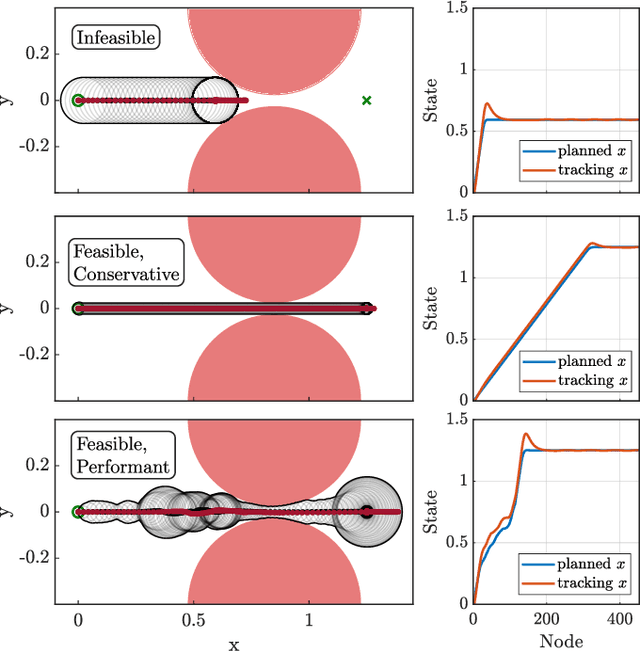

Safe navigation of cluttered environments is a critical challenge in robotics. It is typically approached by separating the planning and tracking problems, with planning executed on a reduced order model to generate reference trajectories, and control techniques used to track these trajectories on the full order dynamics. Inevitable tracking error necessitates robustification of the nominal plan to ensure safety; in many cases, this is accomplished via worst-case bounding, which ignores the fact that some trajectories of the planning model may be easier to track than others. In this work, we present a novel method leveraging massively parallel simulation to learn a dynamic tube representation, which characterizes tracking performance as a function of actions taken by the planning model. Planning model trajectories are then optimized such that the dynamic tube lies in the free space, allowing a balance between performance and safety to be traded off in real time. The resulting Dynamic Tube MPC is applied to the 3D hopping robot ARCHER, enabling agile and performant navigation of cluttered environments, and safe collision-free traversal of narrow corridors.
Robust Tube-based Control Strategy for Vision-guided Autonomous Vehicles
Mar 24, 2025A robust control strategy for autonomous vehicles can improve system stability, enhance riding comfort, and prevent driving accidents. This paper presents a novel interpolation tube-based constrained iterative linear quadratic regulator (itube-CILQR) algorithm for autonomous computer-vision-based vehicle lane-keeping. The goal of the algorithm is to enhance robustness during high-speed cornering on tight turns. The advantages of itube-CILQR over the standard tube-approach include reduced system conservatism and increased computational speed. Numerical and vision-based experiments were conducted to examine the feasibility of the proposed algorithm. The proposed itube-CILQR algorithm is better suited to vehicle lane-keeping than variational CILQR-based methods and model predictive control (MPC) approaches using a classical interior-point solver. Specifically, in evaluation experiments, itube-CILQR achieved an average runtime of 3.16 ms to generate a control signal to guide a self-driving vehicle; itube-MPC typically required a 4.67-times longer computation time to complete the same task. Moreover, the influence of conservatism on system behavior was investigated by exploring the interpolation variable trajectories derived from the proposed itube-CILQR algorithm during lane-keeping maneuvers.
Tube-NeRF: Efficient Imitation Learning of Visuomotor Policies from MPC using Tube-Guided Data Augmentation and NeRFs
Nov 23, 2023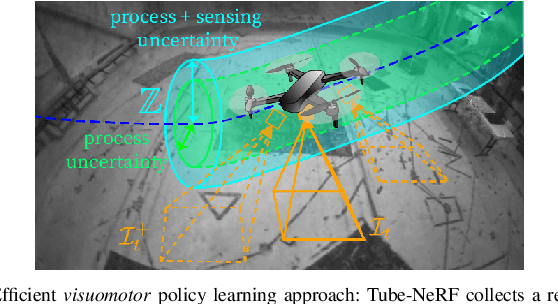
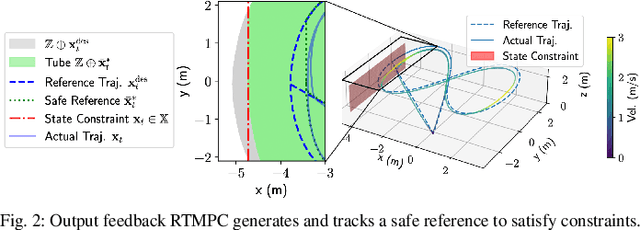
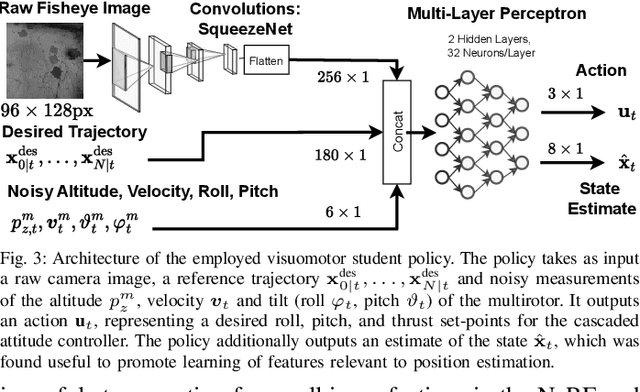
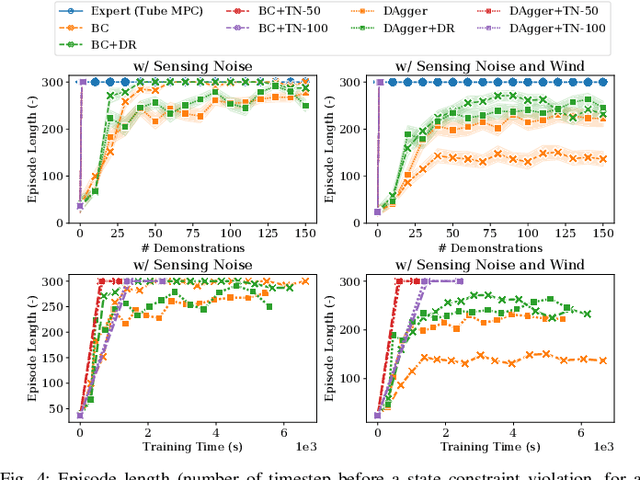
Imitation learning (IL) can train computationally-efficient sensorimotor policies from a resource-intensive Model Predictive Controller (MPC), but it often requires many samples, leading to long training times or limited robustness. To address these issues, we combine IL with a variant of robust MPC that accounts for process and sensing uncertainties, and we design a data augmentation (DA) strategy that enables efficient learning of vision-based policies. The proposed DA method, named Tube-NeRF, leverages Neural Radiance Fields (NeRFs) to generate novel synthetic images, and uses properties of the robust MPC (the tube) to select relevant views and to efficiently compute the corresponding actions. We tailor our approach to the task of localization and trajectory tracking on a multirotor, by learning a visuomotor policy that generates control actions using images from the onboard camera as only source of horizontal position. Our evaluations numerically demonstrate learning of a robust visuomotor policy with an 80-fold increase in demonstration efficiency and a 50% reduction in training time over current IL methods. Additionally, our policies successfully transfer to a real multirotor, achieving accurate localization and low tracking errors despite large disturbances, with an onboard inference time of only 1.5 ms.
Smooth Computation without Input Delay: Robust Tube-Based Model Predictive Control for Robot Manipulator Planning
Mar 09, 2024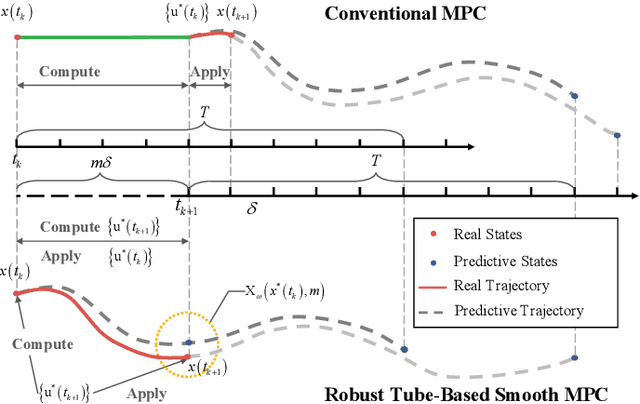
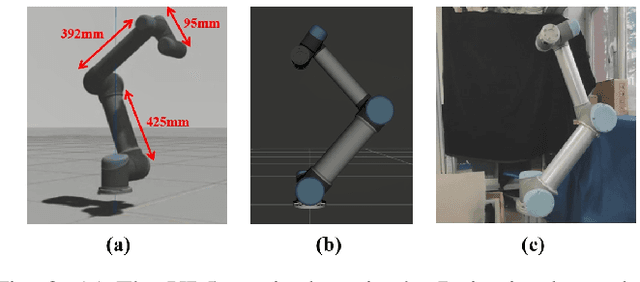
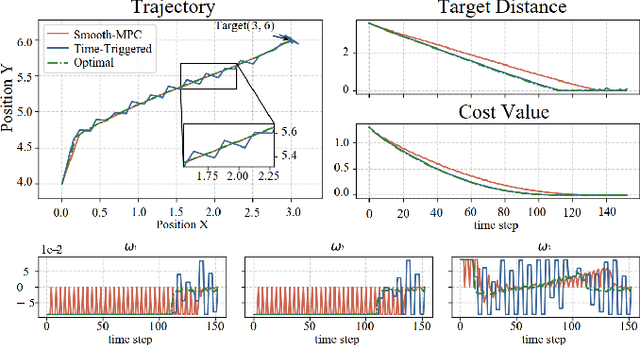
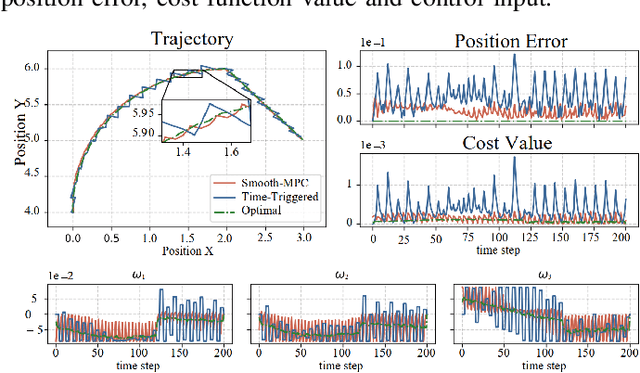
Model Predictive Control (MPC) has exhibited remarkable capabilities in optimizing objectives and meeting constraints. However, the substantial computational burden associated with solving the Optimal Control Problem (OCP) at each triggering instant introduces significant delays between state sampling and control application. These delays limit the practicality of MPC in resource-constrained systems when engaging in complex tasks. The intuition to address this issue in this paper is that by predicting the successor state, the controller can solve the OCP one time step ahead of time thus avoiding the delay of the next action. To this end, we compute deviations between real and nominal system states, predicting forthcoming real states as initial conditions for the imminent OCP solution. Anticipatory computation stores optimal control based on current nominal states, thus mitigating the delay effects. Additionally, we establish an upper bound for linearization error, effectively linearizing the nonlinear system, reducing OCP complexity, and enhancing response speed. We provide empirical validation through two numerical simulations and corresponding real-world robot tasks, demonstrating significant performance improvements and augmented response speed (up to $90\%$) resulting from the seamless integration of our proposed approach compared to conventional time-triggered MPC strategies.
Sub-linear Regret in Adaptive Model Predictive Control
Oct 07, 2023We consider the problem of adaptive Model Predictive Control (MPC) for uncertain linear-systems with additive disturbances and with state and input constraints. We present STT-MPC (Self-Tuning Tube-based Model Predictive Control), an online algorithm that combines the certainty-equivalence principle and polytopic tubes. Specifically, at any given step, STT-MPC infers the system dynamics using the Least Squares Estimator (LSE), and applies a controller obtained by solving an MPC problem using these estimates. The use of polytopic tubes is so that, despite the uncertainties, state and input constraints are satisfied, and recursive-feasibility and asymptotic stability hold. In this work, we analyze the regret of the algorithm, when compared to an oracle algorithm initially aware of the system dynamics. We establish that the expected regret of STT-MPC does not exceed $O(T^{1/2 + \epsilon})$, where $\epsilon \in (0,1)$ is a design parameter tuning the persistent excitation component of the algorithm. Our result relies on a recently proposed exponential decay of sensitivity property and, to the best of our knowledge, is the first of its kind in this setting. We illustrate the performance of our algorithm using a simple numerical example.
Differentiable Robust Model Predictive Control
Aug 16, 2023Deterministic model predictive control (MPC), while powerful, is often insufficient for effectively controlling autonomous systems in the real-world. Factors such as environmental noise and model error can cause deviations from the expected nominal performance. Robust MPC algorithms aim to bridge this gap between deterministic and uncertain control. However, these methods are often excessively difficult to tune for robustness due to the nonlinear and non-intuitive effects that controller parameters have on performance. To address this challenge, a unifying perspective on differentiable optimization for control is presented, which enables derivation of a general, differentiable tube-based MPC algorithm. The proposed approach facilitates the automatic and real-time tuning of robust controllers in the presence of large uncertainties and disturbances.
Efficient Deep Learning of Robust Policies from MPC using Imitation and Tube-Guided Data Augmentation
Jun 01, 2023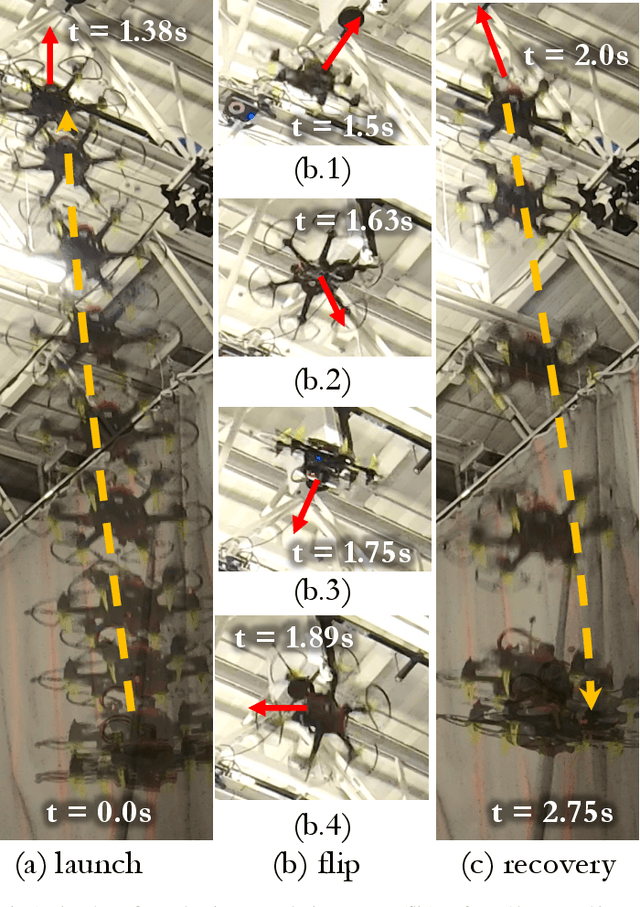
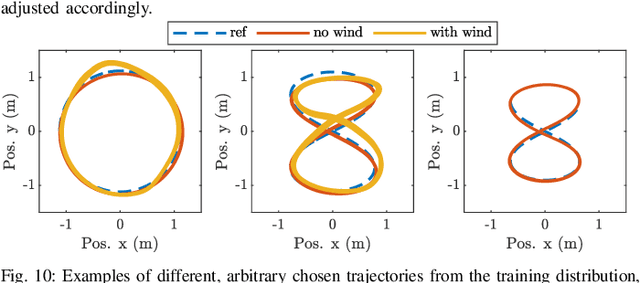
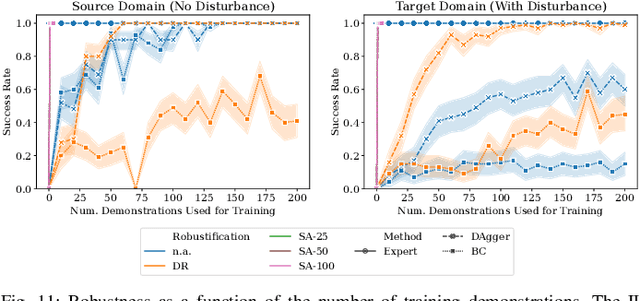
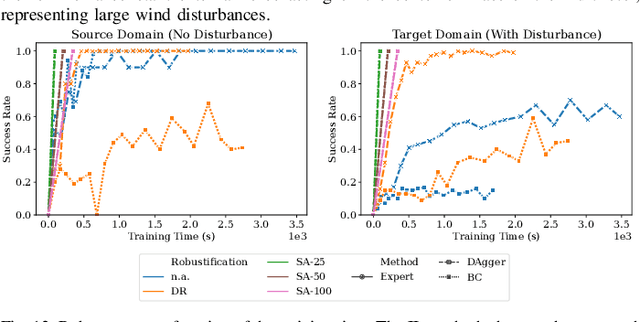
Imitation Learning (IL) has been increasingly employed to generate computationally efficient policies from task-relevant demonstrations provided by Model Predictive Control (MPC). However, commonly employed IL methods are often data- and computationally-inefficient, as they require a large number of MPC demonstrations, resulting in long training times, and they produce policies with limited robustness to disturbances not experienced during training. In this work, we propose an IL strategy to efficiently compress a computationally expensive MPC into a Deep Neural Network (DNN) policy that is robust to previously unseen disturbances. By using a robust variant of the MPC, called Robust Tube MPC (RTMPC), and leveraging properties from the controller, we introduce a computationally-efficient Data Aggregation (DA) method that enables a significant reduction of the number of MPC demonstrations and training time required to generate a robust policy. Our approach opens the possibility of zero-shot transfer of a policy trained from a single MPC demonstration collected in a nominal domain, such as a simulation or a robot in a lab/controlled environment, to a new domain with previously-unseen bounded model errors/perturbations. Numerical and experimental evaluations performed using linear and nonlinear MPC for agile flight on a multirotor show that our method outperforms strategies commonly employed in IL (such as DAgger and DR) in terms of demonstration-efficiency, training time, and robustness to perturbations unseen during training.